Map & Monitoring
Map & Monitoring
Monitoring the detonation
Here we track environmental predictions and sampling related specifically to the detonation at the Iowa Army Ammunition Plant, confirmed for November 25, 2026. This is separate from the regional monitoring below.
Where could the plume travel?
The U.S. Army has published computer-generated maps estimating where lead particles could travel through the air and settle on the ground (scientists call this settling surface deposition). These maps are predictions based on weather and modeling.
Army projection maps for the November 25 plan: mitigated surface deposition and air dispersion (as of 8:00 a.m. CST, November 25, 2026) — no change
Modeled scenario: a detonation on November 25, 2026, 09:00 Central. Current schedule on the Timeline
The Army reports no change from the 7:00 a.m.
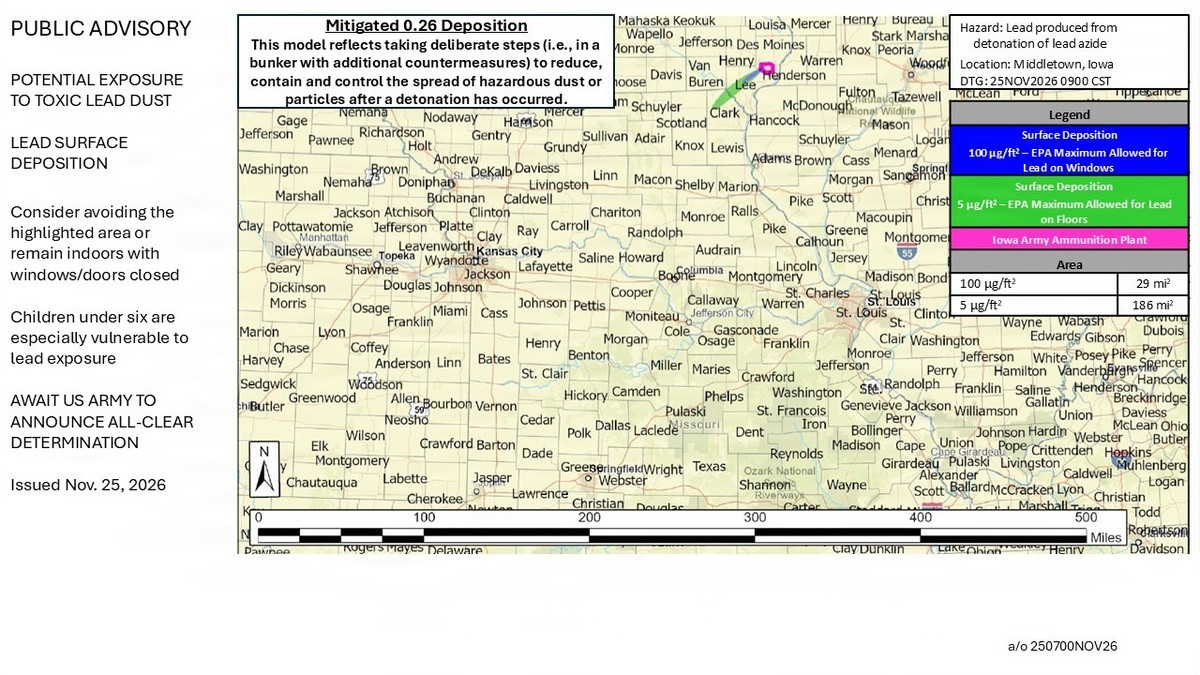
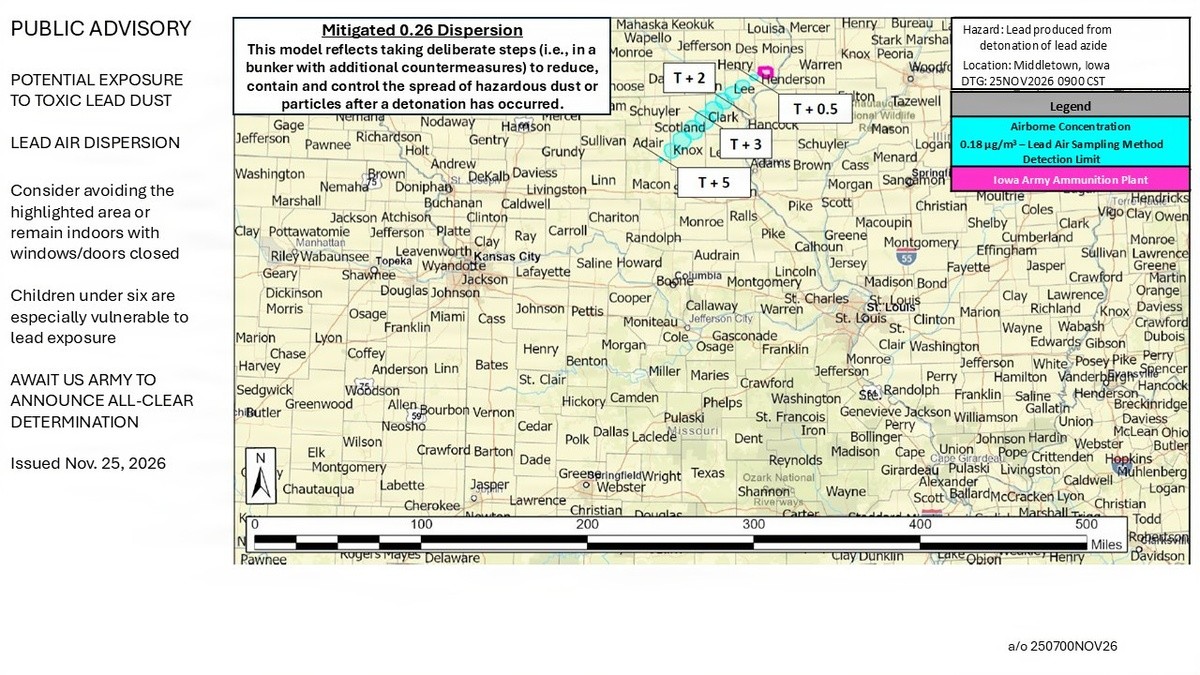
Modeled projection maps from the U.S. Army. Original document
This projection is now on Projection details.
This projection is now on Projection details.
This projection is now on Projection details.
This projection is now on Projection details.
This projection is now on Projection details.
This projection is now on Projection details.
This projection is now on Projection details.
This projection is now on Projection details.
This projection is now on Projection details.
This projection is now on Projection details.
This projection is now on Projection details.
This projection is now on Projection details.
This projection is now on Projection details.
This projection is now on Projection details.
This projection is now on Projection details.
This projection is now on Projection details.
This projection is now on Projection details.
This projection is now on Projection details.
This projection is now on Projection details.
This projection is now on Projection details.
This projection is now on Projection details.
This projection is now on Projection details.
This projection is now on Projection details.
This projection is now on Projection details.
This projection is now on Projection details.
This projection is now on Projection details.
This projection is now on Projection details.
This projection is now on Projection details.
This projection is now on Projection details.
This projection is now on Projection details.
This projection is now on Projection details.
This projection is now on Projection details.
This projection is now on Projection details.
This projection is now on Projection details.
This projection is now on Projection details.
This projection is now on Projection details.
What has been measured?
Comparing baseline and post-detonation samples can help researchers identify changes in lead levels.
The Army has reported collecting baseline samples. EPA reports it had collected over 1,001 combined air, land, and water samples before the detonation, as of November 24. We have not yet obtained the results.
EPA Region 7 publishes a real-time air monitoring and sampling dashboard. Its readings are EPA's and are not yet reviewed or listed here. EPA real-time air monitoring dashboard
Sampling requirements & review details
What the permit requires
The EPA emergency permit requires sampling and monitoring before, during and after the detonation (Condition IV.Q.1).
What the agencies have announced
The Army public advisory of November 15 reports that baseline sampling occurred. The actual results are unavailable in this tracker.
Army sampling before and after the detonation
Says soil, air and water near the site are being tested before and after the detonation so the Army can act where lead is deposited, and that U.S. government personnel will sample after the detonation and publish results when available. Its November 24 announcement adds that stationary air sensors will run along the installation perimeter and in nearby communities during the event, and that mobile teams will collect soil, surface-water and surface-wipe samples along the plume path afterward.
EPA's own sampling
Says it is conducting its own air, water and soil sampling. As of November 24 it reported over 1,001 combined air, land and water samples collected before the detonation, and says it will continue sampling during and after the detonation and report the data in a timely and effective manner. It has published no sample results.
Army cleanup of residential properties
Says that if any residential property tests above 200 parts per million (mg/kg), the RCRA-approved standard it cites, remediation teams will remove affected soil, clean surfaces and restore the property at government expense.
How results are listed
We list published results that include units and a cited source. Results announced but not yet published are marked pending. A result below the detection limit is labeled “not detected.”
Air results are reported per volume of air, usually micrograms per cubic metre (µg/m³). Soil results are reported per weight of soil, usually milligrams per kilogram (mg/kg). Air and soil results use different units and cannot be directly compared.
Before and after the detonation
A sample is placed before or after the detonation using its collection window and the confirmed detonation date and time. Samples collected across the detonation, or with timing too coarse to place, are labeled that way.
The confirmed detonation date and time is November 25, 2026.
Review history
Lead in the air: last checked successfully November 25, 2026, 18:59 UTC (Claude (maintainer)), results found. Review record
Lead in the soil: last checked successfully November 25, 2026, 14:47 UTC (Claude (maintainer)), no results found. Review record
Regional environmental monitoring
20 EPA-listed stations within 100 miles of the Iowa Army Ammunition Plant have collected air quality samples since January 2024.
The map shows historical readings from these stations. Our retrieved EPA data contains no lead (Pb) readings from 2026.
4,540 lead results in river, stream, lake and wetland water from 190 locations within 100 miles, collected January 2015 to September 2026, reported by Illinois EPA, Iowa DNR, U.S. Geological Survey and Missouri DNR.
Of these, 2,879 reported as not detected, 37 as present below the quantitation limit and 1,624 with a value (962 of them below the agency's reporting limit).
Historical routine monitoring: these results were not collected for the detonation and are not a pre-detonation baseline. Total and dissolved lead are listed separately. 2 locations on private land are listed without a map marker.
The U.S. Geological Survey sampled 51 sites within 100 miles once each, between June 2008 and September 2010 (Iowa 21, Illinois 20 and Missouri 10), at three soil layers: 153 lead measurements in mg/kg.
A historical regional geochemical survey with about one site per 1,600 square miles. It does not describe current conditions, residential soil or conditions before the detonation, and values are not estimated between sites.
Survey site locations are not mapped: some sites are on private land. Each site is listed by state and distance band.
Showing all stations, including historical or undated ones.
Stations 46 / 46
No EPA-listed stations match these filters.
- Cardinal Stritch School Lead (Pb), historical listing only
- WASHINGTON & MIDDLE RD Lead (Pb), historical listing only
- LAKE SUGEMA STATE PARK II Sulfur dioxide · Nitrogen dioxide · Ozone · Coarse particles (PM10) · Fine particles (PM2.5)
- MUSCATINE HS - East Campus School Roof Fine particles (PM2.5)
- Muscatine HS - East Campus School Trailer Sulfur dioxide · Fine particles (PM2.5)
- MUSCATINE, MUSSER PARK Sulfur dioxide · Fine particles (PM2.5)
- MUSCATINE, GREENWOOD CEMETARY Fine particles (PM2.5)
- LIBRARY, 40 E. SIMMONS Lead (Pb), historical listing only
- BUFFALO, LW MINING Coarse particles (PM10)
- 125 W 2ND AVE Lead (Pb), historical listing only
- Hayes School Fine particles (PM2.5)
- 405 S.FARAGUT ,WORLD OF OZ DAY CARE DAVENPORT Lead (Pb), historical listing only
- 1400 25TH AVENUE Lead (Pb), historical listing only
- MONROE SCHOOL, 1926 WEST 4TH STREET DAVENPORT Lead (Pb), historical listing only
- CITY HALL 1528 3RD AVE Lead (Pb), historical listing only
- CENTRAL FIRE STATION 9TH AND VERMONT Lead (Pb), historical listing only
- DAVENPORT, FIRE STATION Lead (Pb), historical listing only
- IOWA CITY, HOOVER SCH. Fine particles (PM2.5)
- DAVENPORT, JEFFERSON SCH. Lead (Pb), historical listing only · Carbon monoxide · Sulfur dioxide · Nitrogen dioxide · Ozone · Coarse particles (PM10) · Fine particles (PM2.5)
- 3RD & PERSHING DAVENPORT Lead (Pb), historical listing only
- JOHN WOOD COMMUNITY COLLEGE Ozone
- CITY HALL 619 16TH ST Lead (Pb), historical listing only
- 3600 23RD AVE Lead (Pb), historical listing only
- ROCK ISLAND ARSENAL Ozone · Fine particles (PM2.5)
- 1400 13TH STREET Lead (Pb), historical listing only
- CITY HALL 915 16TH ST Lead (Pb), historical listing only
- SCOTT COUNTY PARK Ozone
- DAVID RESIDENCE Lead (Pb), historical listing only
- CITY BARN, 445 FIRST ST. SW Lead (Pb), historical listing only
- PUMP STATION Lead (Pb), historical listing only
- MCKINLEY STEAM Fine particles (PM2.5)
- Public Health Sulfur dioxide · Ozone · Coarse particles (PM10) · Fine particles (PM2.5)
- CENTRAL FIRE STATION 427 1ST ST SE Lead (Pb), historical listing only
- 1604 DETWEILLER Lead (Pb), historical listing only
- FIRESTATION Sulfur dioxide
- 531 COURT Lead (Pb), historical listing only
- OLIN HALL BRADLEY UNIV Lead (Pb), historical listing only
- 2711 SW JEFFERSON Lead (Pb), historical listing only
- FIRESTATION Ozone
- PEORIA HEIGHTS HS Ozone
- CITY PATROL HOUSE 610 N E JEFFERSON Lead (Pb), historical listing only
- CITY OFFICE BUILDING Lead (Pb), historical listing only · Fine particles (PM2.5)
- 235 E WASHINGTON Lead (Pb), historical listing only
- CLINTON, CHANCY PARK Sulfur dioxide · Fine particles (PM2.5)
- MONROE & JACKSON Lead (Pb), historical listing only
- CLINTON, RAINBOW PARK Ozone · Fine particles (PM2.5)
Water locations 190 / 190
No water locations match these filters.
Loading…
Survey sites 51 / 51
No survey sites match these filters.
Loading…
The interactive map needs JavaScript and map tiles. The station list and each station's page work without it.
Map key
- Other monitoring: sampling since January 2024 (20)
- Historical or undated monitoring station, lead monitor listed (26)
- Multiple stations
How to read the map
Filled markers: stations with EPA sampling since January 2024. Hollow markers: historical or undated listings.
“Pb” (the chemical symbol for lead) marks stations where EPA lists a lead monitor. None has lead sampling since January 2024. 2 stations with recent sampling for other pollutants also list an older lead monitor; they appear as other monitoring.
All markers are existing regional EPA monitors, separate from monitoring set up for the detonation. Each station lists the pollutants in EPA's station record.
The brown dot marks the approximate center of the plant. The detonation point is not marked.
Map key
- Surface-water location with lead results from 2015 onward (188)
- Multiple locations
How to read the water data
A monitoring station was sampled on more than one date; a sampling location was sampled once. Markers show where agencies sampled, not where lead is present.
“Not detected” means the laboratory did not find lead above its detection or reporting limit. It is not a measurement of zero, and limits differ between agencies and years. Some Illinois EPA values are reported below the agency's own reporting limit; they are shown as reported and marked.
Where agencies sample at the same spot, each keeps its own location and results. Analytical methods appear only where the source reports them.
The 100-mile radius is the area we searched for data. It is not an impact boundary. The brown dot marks the approximate center of the plant.
How to read the soil survey
Each survey site was sampled once at three layers: the top 0–5 cm, the A horizon (topsoil) and the C horizon (deeper parent material). Values are shown for each layer as the U.S. Geological Survey reported them.
The layers are different materials collected on the same visit, so differences between them are not changes over time. Values are not averaged across layers or estimated between sites.
About this data & downloads · Download water results (CSV)
About this data & downloads · Download soil survey results (CSV)
About our sources
We gather information from government agencies, courts, universities and news reporting. Learn where our data comes from, how we verify it, and how we preserve historical records in Sources & Methodology.